Trade Maids
Shortening Factory Work

Seen some “MMT is Wrong on Trade” stuff again. It’ll be never-ending until there is a paradigm shift. But as Kiwi friend Kevin Mayes points out1, it is thoroughly insufficient to just rant “Imports are our Real Benefit and exports our Real cost.” Why? Because although it is true, so is essentially a Moslerian aphorism: “Economics is the opposite of religion: it is better to receive than to give.”
Put the two together and you have a dim recognition that the USA being a net importer is benefiting, but not in a nice way — from Chinese factory slaves. (No footnote relegation here, since I think it needs to be explicit: that last sentence is just a vibe. We mean, of course, all factory workers, everywhere, even the USA workers. All are being exploited to one degree or another, with rare long tail exceptions2 and maybe some worker cooperatives.)
It is precisely because “economics is the opposite of religion”3 that we will need to transition to the wealthiest nations cutting back on imports so that poorer nations can have the real benefits. There is a second inversion of a more spiritual macroeconomics here.
First inversion: do not think in terms of currency and current account balance (government scorepoints), think in terms of real goods. Domestically the scorepoints can always be adjusted for a fair distribution, it is a policy choice, so just do not allow your governments to think otherwise.4 They think they are beholden to financial markets, but they are not, except psychologically (falsely).)
Second inversion: Although imports are a physical real benefit, this statement lacks a spiritual & class analysis. “Real benefit for whom?” The nation truly in need of imports is usually not in a net import position. The opposite of Religion with-a-capital-R, the opposite of “The Good.”5
Third inversion: by exporting wisely, benefiting the foreign workers by shipping them our goods, we lose in real terms physically but can benefit enormously spiritually. The world becomes a more peaceful place. But our exports need to go to the foreign workers, not the foreign oligarchs. Euthanize the oligarchs, for they are not the source of anything good, and especially not the source of our tax credits.
Thus, all things fairly considered, we really do want the USA to become less an importer, so suffer the relative real physical loss, since other nations are in greater need of the physical goods. All things fairly considered, the Chinese workers are getting screwed, and probably should not be driven to work as such factory slaves for the benefit of “the west” — the net importers.
New Zealand is in roughly the same foreign worker exploitation basket as the USA. We are benefiting. But again, who is truly benefiting in physical terms? It’s our upper class, those who can purchase the imports without suffering credit card debt.
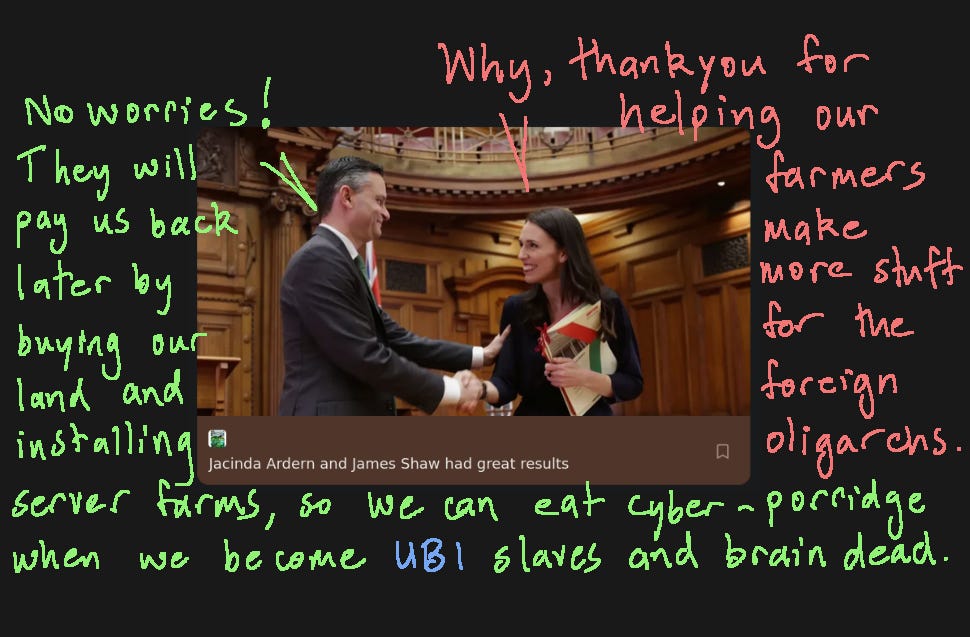
This makes Adern and James Shaw’s trade deals, and Luxon’s trade deals, all the trade deals, rather moot, don’t you think? Trade optimization (or lack thereof) has nothing to do with the capacity of our government to maintain full non-ꕗꖹꝆꝆꕷꖾꕯꖡ domestic employment. It has always been about the willingness of our government to spend to eliminate poverty gaps, and they’ve been, for whatever ꕒꗍꖀ𐝥ꗍꘝꕯꖡ reasons, unwilling.
With this in mind, we can worry about optimizing real terms of trade later, but with a spiritual lens perhaps Kiwis should be working a bit more so we can export more to China so their workers get real compensation for their real losses. (This goes double for the USA?) We reduce our domestic real (physical) losses by euthanizing our rentiers, and thus we gain enormous spiritual benefits. Call me a wild-eyed romantic. I know this’ll probably not happen in my lifetime, but I need to put it out here.
Looking at import/export and current account balances tells you nothing about the spiritual condition of the workers. All workers, everywhere. But if we desire to move towards a more peaceful and harmonious global society the workers need to be given just compensation, and still realize they are always going to be short-run exploited — simply because many people cannot and should not be working, so the typical worker is always going to be producing a surplus. But this is fine, in the long run no one need be exploited: there are times in life when the worker also cannot and should not be working. The point of a decent society is to get to a stage where the just benefits accrue to all, equally, according to needs and modulated by our collective means. Which implies euthanizing the rentiers. It implies completely eliminating the “capitalist” mode of production. The point being to minimize the “exploitation” of workers. Part of this effort is spiritual transformation, so that under a fair distribution system the workers really understand they are producing surplus value, and always will be, but over their whole lifespan they will not on average be exploited, and not only “on average” but a narrow symmetric distribution to that measure as well!
In today’s modernized sense, that does not merely refer to private ownership of the means of production, but oligarchic plutocratic power over the nominal state democracy. Because it is only nominal until such overworld forces are removed.
Seems like pie-in-the-sky hopium or fantasy? Well, forgive me for having hope and injecting it into my veins every day that I can avoid the news media. I think it can be done. I do not know how. As someone recently quipped, this deep state (derin devlit) stuff has made even a putative god-like Nostradamus blush.
You can correct me if I misinterpret Kev The Farmer.
Is there a boss anywhere … anywhere … who is not a complete ꕗꗇꕷꖡꗇ𐝥ꕒ? Well, that’s your long tail event.
This is also way “economics” — as the contemporary profession — really has to also die, and good riddance to it when it gets buried.
I realize this is a friggin’ hard ask. So what? We have to make the demands. They’ll never be our governments until we start forcing upon them our demands. The marxist auto-revolutionary dynamics via “capitalism-as-revolution” is a fiction, it’ll never work. It only entrenches oligarchy and ends in a UBI pittance to suppress actual worker revolution. The Marxist analysis of monetary systems fails to recognize this.
I realize Religion as so defined may not exist. It is certainly hard to find in any socially congealed form. But I do honestly believe it exists in the hearts of all good people, most people I know.
The MMT economist I’ve learned the most from on the development question is Fadhel Kaboub, whose ideas I’ve accessed (since I’m just an interested amateur) via his many interviews on different MMT podcasts (The MMT Podcast, Macro’n’Cheese, Activist #MMT), esp on his interviews the topic of monetary sovereignty.
What do you think of his approach?
Education as part of the job guarantee. Ideas (imagination) change reality. A lack of imagination is holding humanity back at the moment.