Tariffman vs Moslertron
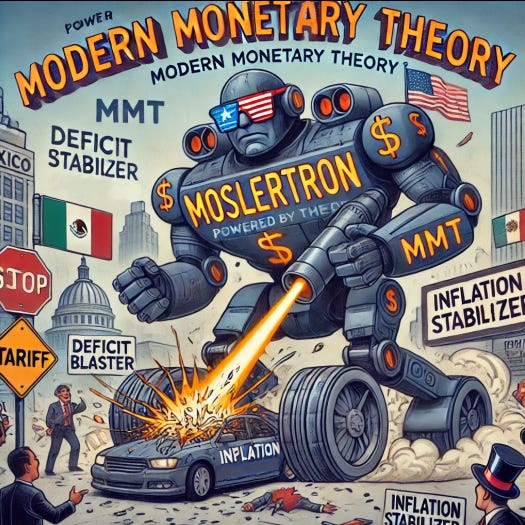
Mexico should wheel out the Moslertron from Deep Cover

Over on my more education oriented Ōhanga Pai github we should write a detailed chapter on the concept and impact of tariffs. However, they are not hard to grok. The bottom line is they are stupid and pretty bad, for everyone. But with an MMT lens we can see they are often the worst for the country imposing them! How?
How can the current era (c. 2025) USA regime be so wrong? (And who would’ve thought??? 🤣) More on this later. It’s hard stuff to write about since it is gut-wrenching on top of the backwards macroeconomics. Sometime what the Musketeers do could greatly benefit the other nations, but the policy responses of the other nations are not willing to take the win handed them by Trump. End effect is more like lose–lose situation, by dumb choice.1
At the time of writing & editing things are looking pretty bad for folks in the USA, with Andreesson and Yarvin, two-of-many idiot fake-intellectuals who seem to think the Earth is a D&D game or Marvel™ Comic, gaining air-time. My article today is to (vainly no doubt) warn other governments things do not need to be bad here at home.
But instead talking heads in NZ media are spouting garbage about how the Trump tariffs are going to hurt NZ. This is nonsense. Only the NZ government can allow the hurt, since they have the full means to avoid all the pain. But they won’t. Hence (paradox of self-defeat) there will be pain in NZ and the talking heads will be proven correct in outcomes! But they are wrong on causes. It is tragic.
Snappy Version
Michael Green posted a piece at YIGAF that exposed some sort of “celebrity chef” figure who was touting himself as enthusiastic about the Trump tariffs. For the life of me I could not tell if it was deeply sarcastic or plain stupid, nor whether Green was also stupid or just so Σ for getting the sarcasm.
I hazarded a guess at “plain stupid”. So I posted this comment as an antidote:
One ought not be excited by tariffs from any angle? (I would say yeeaah.) It is all madness. But if a government knows their monetary system and their full available policy space they can always afford to give Trumpistas their metaphorical middle finger. The tragedy of these tariff-wars is that governments do not understand, so will likely hurt themselves (or their people), unaided by Mr Trump. It is all about the policy response, not what the other guy does in such matters. US manufacturers want to sell you more of their stuff? You can buy. They do not want your stuff? You get to keep it (or sell to someone else). All the better for the someone else.
Just like the sanctions placed on Russia back-fired, the USA “leadership” have this backward too, yet so do the governments Trump is targeting. They aught to realize they can win big from Trump’s insane trade policies.
The finance bros never pay heed to me, so I won’t get any blow-back. But I would be interested to know if any Ōhanga Pai readers think any differently. Note: I am not an active academic researcher in this area nor econ journo who thinks about tariffs all day long. But you do not need to in order to appreciate the mainstream economists have things backwards as usual, and so the government policy responses on both sides will likely be all screwed up too, since for some godforsaken unknown reason politicians and policy wonks still seem to think credentialed economists have useful things to say which a 12 year old does not intuitively comprehend.
In trying to hurt Trump country you will end up hurting your home country.
Retaliation is for war and Prisoner’s Dilemma, not for Trade.
OK, that was the Moslertron version.
The Long Winded Version
Here’s a sober MMT breakdown of some of the arguments around and implications of tariffs.
Government Revenue and Sovereignty
MMT posits that a currency-sovereign government, like the USA, which issues its own fiat currency (USD), does not need to generate revenue through taxes or tariffs to fund spending. Instead, it can create money as needed, constrained only by inflation risks.
From this perspective, the argument that tariffs “raise revenue” for the U.S. government is economically irrelevant under MMT because the government does not require external funding to operate. Instead, tariffs act as a policy tool with other effects, such as influencing trade flows or domestic production .
Impact on Importers and Consumers
Tariffs are effectively taxes on imports, which are paid by U.S. businesses importing goods, not foreign exporters. This raises costs for U.S. importers, who often pass these costs onto consumers in the form of higher prices. This can lead to inflationary pressures and reduced purchasing power for households .
Foreign exporters may respond by raising prices or diverting sales to other markets, minimizing their own economic harm . Thus, the burden of tariffs could disproportionately fall on U.S. entities. How disproportionate? Entirely depends on the other country’s government policy response level of MMT awareness. But you know… it could just end up in misery all around.
How can I say that? Because the whole idea is to “increase government savings”! An inapplicable notion when your government is the issuer of the currency. It amounts to demand withdrawal elsewhere. The key question is where is that else? Again, that’ll be a foreing governemtn policy response determination.
Some economics think Canada and Mexico will feel most of the burden, but this is false. An MMT perspective would say that’d be true only if the Mexican and Canadian government “retaliate” instead of using the more appropriate MMT recommended fiscal adjustments. If a foreign entity marks prices upwards, the domestic currency can always be re-gauged. This is not inflation. It is a one-time adjustment in domestic prices that hurts no one. The wage has to go up too, all prices. One-time adjustment. In fact, it is a good excuse for a wise government to boost low-end wages more. Pushing all prices upwards but from the base.
(If a general price re-gauging is desired, this is always the better way to implement the gauging. Just you try stopping the trickle-up! You’d need to euthanize the rentiers — which is a much longer term project.)
There are other policy responses too, such as seeking other buyers for your exports, and the governments of Mexico and Canada can use some light subsidies to help the firms dependent on exporting if they so choose. (This can also help the one-time price adjustment in a well-targeted fashion.) But the real terms of trade are what are more important, the imports! Thus retaliation against the USA by making U.S. imports more expensive for your own economy is the stupid policy response.
Unfortunately this does not mean Canada and Mexico will not go down the stupid path.
Remember: it is not about jobs!
Tariffs are never about jobs. If the Tariffman (resp. Tariffwoman) wanted more jobs created in the USA (resp. Mexico), they could employ idle workers. Almost in any industry, probably even with some executive orders, if not, Congressional approval only is needed. The Treasury and FED (resp. Central Bank) take marching orders from Congress (resp. Parliament).
They could even construct houses and whole ghost cities for no one to live in. The sophisticated Chinese version of Keynes' “digging ditches and fill them in again”. They at least had something to show for the construction company grift.
The central government can always employ anyone not employed by the private sector, without incurring inflationary pressures. This is simply a policy choice. After first expanding public services if desired, the policy choice is then whether to run an unemployed labour buffer or a fully employed labour buffer.
Trade Deficits and Real Goods
MMT views imports as a net benefit because they provide real goods and services in exchange for financial claims (currency) that the U.S., as a sovereign issuer of dollars, can create at will . Conversely, exports are seen as a cost because they involve sending real resources abroad.
Imposing tariffs reduces imports, which MMT proponents argue harms the U.S. by limiting access to these real goods while doing little to benefit exporters who can find alternative markets . This aligns with the critique that tariffs hurt the U.S. economy more than they help.
Economic Costs of Tariffs
Most empirical analyses shows that tariffs reduce GDP growth, employment, and investment in the long run. For example:
The proposed Trump-era tariffs could shrink U.S. GDP by up to 1.3% and cost over a million full-time jobs if fully implemented.
Tariffs also lead to dollar appreciation, making U.S. exports less competitive globally and further harming domestic producers reliant on international markets (see “A global economist’s take on tariffs” ).
Without complementary industrial policies to boost domestic production, tariffs alone fail to achieve meaningful economic benefits while imposing significant costs on consumers and businesses Ibid. .
Some Recent Public Responses
This note from Ghost was worth highlighting:
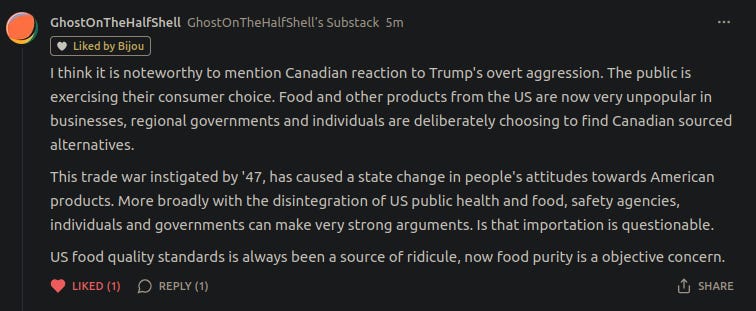
Is this relatiation? I do not want to say it is, since choosing to source goods domestically is a good thing in any case except when labour conditions at home are worse. But it is hard to make the case Canadian workers are more oppressed than US workers. The possibly higher cost of Canadian goods is something the Canadian state govenment can always make the appropirate fiscal adjustments for to ensure full employment. (The fact they are not already running a full employment of Canadians policy is a disgrace.)
It is also fair to say I over-state the case for stupidity and backwardneess of macroeconomic capacity for decent policy responses. Here is Ghost again pointing out that — government policy responses often lacking — firms and households who are able will find work-arounds. My slight push-back would be the feral economy can only go so far in making the working class whole, and the government bears the moral obligation to bridge the remaining gap caused by foreign monopoly powers or malignant monopolies more generally.
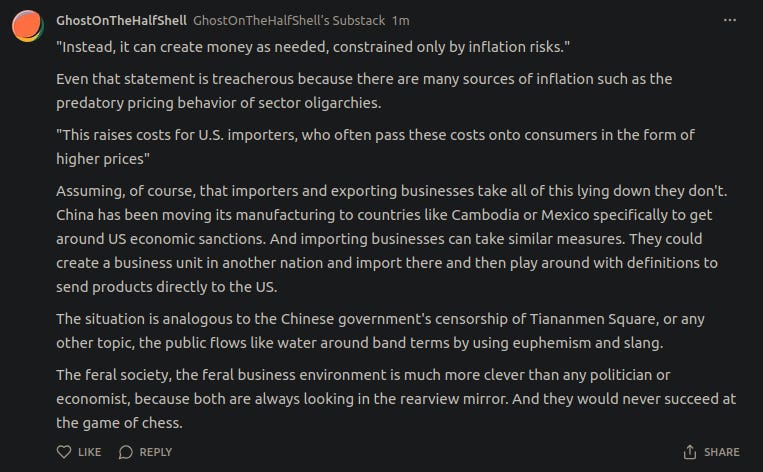
What I have an on-going disagreement with Ghost about is the inflation question. Predatory pricing power should be stamped out, true. However, a government can always push up the wage to re-gauge The issue is, which I painfully recognize, that they don’t immediately and there is hysteresis! But they could, before the legislation to wipe out the predatory monopolists is implemented (tax/fine away unrightful profiteering &c.).
I would concede I cannot know which policy options would be easiest to get first, or if the order matters. Likely they’d be in parallel, since any government recognizing the inflation harm can be immediately eliminated would also recognize the need to stamp out predatory monopoly pricing. The feral economy meanwhile flows around the gaps and cleanses the system, but I do not think it can ever pump out all the sewage. The governments must learn their role to make people whole.
Conclusionista
Recognize most of the Three Musketeers2 doctrines are just designed to cause havoc. No other rhyme nor reason is needed for them. But you have ways to avoid the havoc if you have the pleasure of living somewhere else and have government powers.
From an MMT perspective, tariffs are counterproductive for a currency-sovereign nation like the U.S., as they harm domestic consumers and businesses while reducing access to beneficial imports. Empirical data supports this view, showing that tariffs depress economic growth and employment without significantly benefiting domestic industries unless paired with broader industrial strategies.
The appropriate policy response of a government feeling it’s exporters are going to be hurt by the tariffs imposed by Tariffman is to; (a) recognize your exporters have no place at any trade negotiation table on your end, their interest is in the wealth of the foreign buyers, and the suppression of your domestic workers. (b) You can always ensure full non-ꕗꖹꝆꝆꕷꖾꕯꖡ employment and have a great standard of living. (c) There is always a buyer for your stuff. Judicious fiscal adjustment can avoid all the pain, can avoid 100% of the pain.
Addendum
I recognize some of the concerns in this article are a bit moot given the take-over of US Government by Silicon Valley and the residual neoreactionary oligarchs. It is worth bearing in mind (in case you are not enjoying your depression and anxiety sufficiently robustly) Kamala Harris was an enthusiastic Silicon Valley tech bro booster too, just with happier memes.
Nevertheless the Trumpistas are an extreme hazard to all good people. And thanks to Ghost for this stern read here “Capture of U.S. Critical Infrastructure by Neoreactionaries”, The Musk King Memo shall we say. It is time to Defund Musk, his governance is too big. Must be compensating for something, poor chap. Why the hell does everyone else have to suffer for it? But who is there in US government or on the streets with the power & courage to defund Musk?
I don’t get paid to write Ōhanga Pai so I am not going to go to the effort of backing-up my claims with hard data. That’s your homework shoudl you acccept it. You should in any case not take for granted what I claim. I just offer a simple-minded MMT analysis. Whether it includes sufficient realpolitik or not is highly debateable.
Trump, Vance, Musk — but I really mean all the monarchist Yarvinheads collectively. Theil, Andresson, Land, et al. Disgraceful that some leftist Lacanians give a few of them a platform.
"Instead, it can create money as needed, constrained only by inflation risks."
Even that statement is treacherous because there are many sources of inflation, such as the predatory pricing behavior of sector oligarchies.
"This raises costs for U.S. importers, who often pass these costs onto consumers in the form of higher prices"
Assuming, of course, that importers and exporting businesses take all of this lying down, they don't. China has been moving its manufacturing to countries like Cambodia or Mexico specifically to get around US economic sanctions. And importing businesses can take similar measures. They could create a business unit in another nation and import there, and then play around with definitions to send products directly to the US.
The situation is analogous to the Chinese government's censorship of Tiananmen Square, or any other topic, the public flows like water around banned terms with euphemism, metaphor and slang.
The feral society, the feral business environment, is much more clever than any politician or economist, because both are always looking in the rearview mirror. And they would never succeed at the game of chess.
I think it is noteworthy to mention Canadian reaction to Trump's overt aggression. The public is exercising their consumer choice. Food and other products from the US are now very unpopular in businesses, regional governments and individuals are deliberately choosing to find Canadian sourced alternatives.
This trade war instigated by '47, has caused a state change in people's attitudes towards American products. More broadly with the disintegration of US public health and food, safety agencies, individuals and governments can make very strong arguments to restrict imports based on public health concerns.
US food quality standards have always been a source of ridicule. Food purity is now an objective concern.