You've Been Penrosed
A Shakespearean tragedy of mathematical brevity proportions

The play in six parts:
Managed to briefly catch Sir Roger Penrose over lunch in an interview with a pompous chad. There is no escape from the politics though, macroeconomics seems to touch all tragedy. (Why were the Montagues and Capulets pitted against each other, pray tell?)
In my misspent youth I might have thought Penrose to be the old fuddy-duddy, but although intellectually and emotionally I am still about 16 years old (by accounts from friends and family), I think Penrose is the far better thinker and human being on display. The bearded chad looks1 like a lab creation of the Mars King straight out of the chad wing of the Tesla factory. May their stocks unceremoniously plummet.
The Other Gödel Argument
More than once Penrose tried to explain how people misunderstand the “Gödel Argument”. This is not the mathematical theorem that proves Peano Arithmetic (and any more powerful axiom scheme) cannot be both complete and consistent. What Penrose means is the meta-mathematical argument that from Gödel’s result we, human beings, can comprehend that machines (meaning algorithmically driven systems) cannot possibly be conscious.
It is an interesting argument in philosophy with a long pedigree, and even Gödel weighed in by noting it is not logically impossible for us to “grow” or “evolve” machines that might be conscious. However, Gödel did not believe conscious intelligence can be derived from physics. So there is no possibility of emergent consciousness from within physics. In other words, Gödel also believed consciousness is a spiritual or non-physical phenomenon.
Penrose also is good when he affirms that by the word “Intelligent” most ordinary non-stupid people mean “conscious intelligence”. Thus when the tech-bros use the weasel words “Artificial Intelligence” they are invoking a cloud of concepts that are highly misleading. They are certainly deliberately political, they politically mean to imply machines can think, can be conscious, which is false*. It is also proving somewhat destructive to civil society, so in the books I admire that’s also morally false.
*In fact we do not really know. But that is the whole point. If thought and qualia-filled sentience were physical then we could know.
However, Penrose does a good job in making the case highly convincing that machines certainly cannot ever “think” or become conscious. The computational architecture is not the correct type of metaphysical substrate that can support consciousness. Computational architecture can support something that is already conscious. And computational architecture can mimic intelligence. But it can never become Intelligent. Intelligence connotes first-person subjective experience. Following rules, however complex, and however ingenious seeming the input–output responses is not intelligence. It is blind obedience to the computational rules.2 This is true even if pseudo-random numbers are used to generate variety, as in genetics.
But Are Humans Not Mere Physics?
This is a common rebuttal. Maybe humans are just physical systems? If so, then there is no obstacle in principle to designing or evolving conscious machines, since we know we are conscious and machines are just physics. This would be true, if humans are “just physics”.
Penrose, for his part, believes that physics is not computational, so that is his “out”. It is a funny stance, and will be the ending of this essay as a tragedy. However, if you want to avoid the tragic I suggest just take Penrose as a fuddy-duddy and that when he says the special physics driving our intelligence is not computational, he means it is spiritual. That is a very odd and misleading way of defining the scope of Physics. However, it is a charitable way of interpreting Penrose, since he is at least a platonist. (What is platonism if not belief there are non-physical realities?) So I would say Penrose is bordering on being inconsistent in his beliefs. Which is perfectly fine, since he is not a formal system.
However, you should never accept the above heading’s premise.
Humans are not just physical.
No one would’ve thought back in say the 1980’s that this would become political. Except people like myself. We knew way back then what was at stake. It cannot be that hard to see, I was still in high school and woefully under-educated.
Douglas Hofstadter’s GEB chickens have come home to roost. He, like Geoffrey Hinton, is now scared of AI.
His fear is thoroughly misplaced. The entities he should be downright scared of are the techno-monarchist techbros and their oligarch donors. There is nothing to be feared about originating from a machine. All the computer systems deployed were, and are, and will be, deployed by thinking semi-intelligent human beings.
The problem to worry about is the semi-intelligence, not the artificial-intelligence machines for stochastically generating strings.
One has to wonder and ask the question are Hinton and Hofstadter and their ilk secretly in cahoots with the Silicon Valley, Mumbai, and Shanghai Coop techbros? I’d say probably not, but it is hard to be convincingly assured, since all their fear and concern is directed 180 degrees away from the real dangers.
For what it is worth, and it might not be worth much to you if you are among the normie cynics, I have absolute faith human society will not allow the techno-monarchists to rule over us, I think that is not a possible scenario, it is also SciFi, just like the idea of an AI Superintelligence is pure SciFi, and can never become fact.
What I worry about is all the political energy wasted on preventing IT system overlords from gaining too much more political power (it is already far too much). If these techies were moral beings we would not have this wasted effort, and could get on with the other pressing issues of gaining sustainable economic development and (humble) prosperity and peace for all. A moral being, for one, does not even seek worldly dominion and conquest over others.3
We just do not need yet another completely avoidable crisis to add to the poly-crisis. The fear of Ai is an artificial crisis. Fear of the tech oligarchs is not, but is needless since oligarchs should simply not be allowed to exist, and we have the collective means to ensure they do not — the apparatus of government. Our bind is that at present the oligarchs control our government. If a well-educated geek or nerd still has a residue of moral development in their soul, they are able to wake up from the Cyberpunk daydreams and delusions and realize things on the ground for the working class are very real and urgent. The tech-nerd tools are not needed to help us prevent climate catastrophe or transition to post-capitalism. All we need for those tasks is already to hand, and within our souls. Too many people are veiling their spirit with the shroud of materialism.
The Block Universe Implications
There is a very simple, elegant, and scientifically rigorous way to know humans are not mere physics. This is the 4D Block universe perspective, given to us by Einstein. I cannot do it justice here, because it is not the main theme of this essay. So I beg your charity in taking the brief synopsis to heart with some generosity.
Einstein revealed that time is on the same metaphysical footing as space. His theory shows that our cosmos can be considered, on purely physical terms, to be a great whole. A One that is comprised of Many. A 4D Block, although marvellously infinite in extent (potentially) and infinitely rich in structure.
However, a consequence of this view is that physics proper has no notion of causality and flow of time. These are not physical concepts. Even life is a non-physical concept. For what can it mean that an organism’s life and death are both physically pre-existing?
Of course, we explore physics using time evolution stories, because we have to! We only have access to data about the past. The notion of “the past” is a perfectly good physical concept, it is defined (relative to a frame of reference) by light-cone structure in the 4D spacetime.
Yet, we experience life, so do the mice. We experience a psychological flow of events, an order to things, and so do the other beings. We feel the cocoa stimulants, and so do the elephants. To us water is a healing balm, and for most creatures a source of calm. Although some people take the black-pill, we all still have free will.
How are we thus to reconcile these two pictures? There is obviously life, and yet physically there is no life. For a proper science we must reconcile these views, science of any good repute cannot leave this dangling.
The only sensible and logical reconciliation is that life is non-physical. We experience the cosmos of spacetime “from without” not “from within”.
As mentioned, I cannot do justice to this reconciliation in a brief paragraph or two, but if you are a true geek and like to geek things up, then I highly recommend reading computer scientist Scott Aaronson’s essay, Ghost in the quantum Turing Machine. Better than anything Doug Hofstadter ever wrote (in terms of geekiness), though Hofstadter did write some beautiful essays on creative analogies, and language translation, see Le Ton Beau de Marot.
That’s the important stuff out of the way. Now for the goofing off with the Gödel Argument.
Machines Cannot Be Intelligent
So first, we take “intelligence” to be sentient subjective consciousness, but combined with “smart” input–output response. (This is a little circular, since “smart” is a synonym for “intelligent”, i.e., also connotes subjective consciousness.) Self-reference seems to always arise one way or another when we use mere language or symbolism to talk about consciousness and minds (not the best read, but still entertaining is Hofstadter’s I am a Strange Loop — being dopey about Ai does not mena he does not still write like the best of science expositors).
The point is, the behavioural events (the input–output) is only one partial objective measure of intelligence, it is not the source and not the complete account. It cannot be a full account because intelligence is subjective. To “be intelligent” is also to know you are acting intelligently — not just unconsciously.
A conscious soul (whatever it is) is necessary here by definition. If you are going to only consider behaviour & response then you are using a different meaning. I would not call it intelligent, since that misfires peoples semantics. Purely behaviour–response mechanisms are mindless task-solvers. Maybe even most animal species are mindless. Who knows? Do you know what it is like to be a Bat? Maybe there is nothing that it is like to be a Bat.
The point is not to denigrate Battiness, but just to point out that you can never know. That is the point.
To quickly recap the last few paragraphs: it is necessary to be conscious to be intelligent. But one may be conscious while being “not very bright.” (A good metaphor by the way, the illuminating of knowledge is intelligence.)
Intelligence is a relative condition, not ontology. We are all conscious and more intelligent than the Caveman. (I guess!🤣 Maybe not uniformly so,… can you make fire without going to the supermarket? Yeah, but your intelligence is not comparable like this, since if in dire wilderness emergency you probably could manage to make fire, the Caveman is just doing it almost mindlessly from rote experience.)
((Actually, that little aside is a good illustration of how nuanced the word “intelligence” is, which is always a warning red light for people who use the word too simplistically.))
Not only can machines not be intelligent, we cannot package intelligence ourselves and press it into a machine (uploading your consciousness, say, as in fantasy Cyberpunk). Listen-up Mr Techno-geek dude and Ms Cyberpunk Chick— it is a fantasy story! You do understand the meaning and function of fantasy literature? No?4
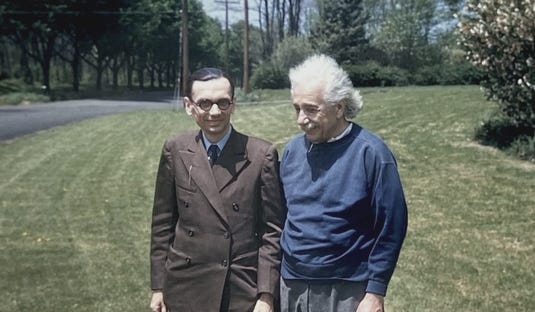
Back to Penrose and Gödel. Although, I would prefer to have lunch with the great logician and his good friend Einstein.
The Subtlety of Understanding
If intelligence is active use of consciousness to solve tasks not “mindlessly” (can you taste yet the circularity and self-referential things associated with consciousness and spirit?), then understanding is the more passive use of consciousness to contemplate on the semantics or meanings of things.
This has no place whatsoever in the mathematics of Gödel’s Incompleteness Theorem.
By the way, for n00bies: Gödel’s theorem is best understood meta-mathematically as implying all formalizable mathematics more powerful than Arithmetic is incomplete — meaning there are true statements in formalized arithmetic that cannot be proven. Why? Gödel only ostensibly proved formally that Arithmetic cannot be both complete and consistent. Well, the answer is because no one of sane mind understands Arithmetic to be Inconsistent. Everyone assumes Arithmetic is consistent, or these days the broader foundation of axiomatic Set Theory. We believe this formal system to be consistent, on faith. Hence by Gödel’s Theorem Arithmetic must be Incomplete.
However, the Penrose argument is about more than having faith in the consistency of Arithmetic. It goes beyond faith into profound understanding that the axioms really are consistent, or if not, there is a wrinkle that can be removed. (Which historically happened, with Russell’s Paradox removing an inconsistency in Gottlob Frege’s scheme.)
The thing about Penrose’s non-mathematical use of Gödel’s Theorem is that this subtlety is important for understanding the human mind (or any other sentient mind). Why? It is because we understand basic mathematics.
First you must appreciate there is no semantic content in axiomatic mathematics per se. It is a formal system, and can be “put on a computer” to crank out theorems that are true relative to the axioms. Nothing comes out of such computations that was not implicit in the axioms. No new knowledge is created, but new theorems are revealed.
It is because we are thinking beings that these new theorems we might crank out by mindless computations, are in fact new knowledge. It is a remarkable thing. Mathematics is essentially “all finished” when you write down your axioms. But because there are true statements that have no proof there is endless richness in the study of mathematics. Not just because you cannot deduce all the theorems in your own head, but also because no machine whatsoever can tell you which theorems are true but unprovable.
We have no idea from mathematical study that the axioms are themselves true meta-mathematically (i.e., true in all possible worlds).
The crucial starting point is that the axioms mathematicians have slowly over centuries converged upon are understood to be unassailably consistent! This is as true as an axiom scheme can get, if it is not to be physically interpreted. (Physics is different, since axiom-like postulates of physics theory can be tested and ruled out even if a set of them is self-consistent, like String Theory).
Now I hope you understand what is at stake. We understand mathematics because we are conscious spiritual beings. We can understand the axioms are consistent, even though there is no way to prove this absolutely.
((The “spiritual” is redundant here, consciousness implies one is a spiritual being. If you can understand the distinction between moral ‘right’ and ‘wrong’ or relative acts of ‘good’ and ‘less good’ then you are a spiritual being. You can understand without ever communicating this, it could be entirely internal and subjective. No behaviour–response is required, in principle. In practice of course general life and nonsense confronts you with unavoidable choices which demonstrate your understanding.)
In short: our conscious mind’s intuitions concerning very elementary simple axioms are the only proof we have and need that Arithmetic is consistent. If our axioms are not simple enough to be intuitively obvious, then mathematicians must work harder on the philosophical foundations of mathematics. But by the mid Twentieth Century it could be said this project was finished for at least two or more different axiom schemes. Although different these schemes must agree on the subset of theorems covering basic finite Arithmetic.
The areas on which the different axioms schemes must agree is what we can call the platonic realm of mathematics. We do not know what this encompasses, but most mathematicians presume it at least includes Arithmetic, for which the Peano axioms are one scheme.
Also, we already know a few theorems that cannot be proven with these axiom schemes. The ZFC scheme for example famously cannot determine the truth of the Continuum Hypothesis, among several other theorems.
Penrose summed things up in one line, which would suffice for all people of mature understanding:
“Conscious understanding allows you to see the rules are true, and thus to go beyond the rules."
Meaning, in short, that by understanding you are proving (to yourself) that you are not a machine, nor a result of a computation, physical or otherwise.
In our tumultuous times, this is a political statement. Policy-makers need to take heed, and not cede ground to the ill wills of technocracy.
Before I finish this Shakespearean Tragedy issue of Ōhanga Pai, I want to offer the positive light. Elsewhere I have written about how it is rational to believe in the spirituality of the human soul (and other sentient beings). Those essays are for the faithful but also offered for the wavering agnostics. I regard faith as illegitimate if not founded upon science, knowledge, wisdom and reason. If you employ these attributes then some mysticism is licensed.
Those essays are not proofs for all, nothing logical can ever be a proof for all, because one can always choose to deny the axioms. The meaning of a good axiom is that you cannot reduce it to any simpler notion.5 In particular, an axiom cannot itself be proven (or it would then not be an axiom). However, honest faith within and understanding of the axioms is possible.
That’s the Light. Now the darkness.
The Defeat of Penrose
Here, in the middle of the conversation , Penrose loses the plot himself, right after accusing the Ai crowd of losing the plot. This was very sad to hear, but I’ve heard it before from Penrose and I can only shrug. Meet your heroes with a fistful of laughter.
I mean without such a fistful, this is very, very depressing for me.
He claims he is a Physicalist, so denies the reality of the immaterial Soul. I can understand a physicist adopting physicalism for research, that is what I do. But it is inexcusable to take physicalism to become totalizing. Adopting physicalism is perfectly fine and indeed appropriate for restricting a domain of inquiry — but when stretched to a metaphysics it is philosophical totalitarianism, and thus plainly wrong. It is anti-philosophy. Why I can say it is “wrong” is because you just cannot possibly know! So why needlessly bias your philosophy? It is madness.
The same goes for Idealists who totalize Idealism.
Totalizing a metaphysical bias is not only strategically a false step, it is not only probabilistically incorrect, it is also against the love of knowledge and wisdom. I do not blame Penrose, he grew up right in the middle of the era of emerging technocracy, neoliberalism and Positivist and Materialist paradigms, which the wonderful soul called Gödel knew to be a “prejudice of our times”.
Hey, if you listen to the interview you will know I am not just going by looks.
It is what many workers have to endure under the capitalist mode of production — yet they are not blind, and they act with mind.
Which tells you something about priests and clergy and all other ruler classes. Nevertheless, I read a bit of history, form time to time, and understand great unified empires have been traditionally the wellsprings of long periods of peace and stability. However, it is not the ruling class that really acheives this, the history books leave out the working class story.
Stanislaw Lem: "… most science fiction is to authentic scientific, philosophical or theological knowledge as pornography is to love." I would go further than Lem’s other comment on SciFi, and directly address those like Ray Kurzweil and Eliezer Yudkowski as intellectually trapped adolescents. I would say teenage fantasy passing itself off as prophecy is a cultural cancer.
This is another type of self-reference, but quite subtle: who gets to say what is “good” or “simpler” and if you obtain algorithmic minimalism (simplicity) how do you know? Will it not be premised upon some axioms of arithmetic being true?
The prejudices of our times have much to answer for. How we can we recognise them for what they are when they built the web in which we sit. How does the spider discover beyond the edge. How do we step out into nothing in order to see. Your subject matter is way beyond me but your writing on it fascinates me. The thread of it and the connections to things that I do know a little about. The sparking of recognition, dot joining. It makes me smile.
Totally agree. The collective knowledge is for everyone's benefit but often jealously guarded by bad actors who do not understand the whole is greater than the individual. The spider analogy has stuck with me from a book I read once called Timelines. And no not michael crichton. If I can find it again Ill send you the link.