Experimental Essences
The fragrance of The Real

There is a big frustration I have with T4G, which is trying to figure out which way T4G says the probes for “quantum gravity” should go. This is why one needs research staff.
Martin Plávala has a paper on one set of experiments that should reveal something of the essence of “quantum gravity”.
But,
(a) what bit of essence is that exactly?
(b) what would T4G predict?
The Hanover Institute (here) put up a video discussion of the paper for those who cannot read.
The Theory Confinement
I liked the chart Plávala drew which illustrates how the experiments should be able to narrow down viable theories of gravity.
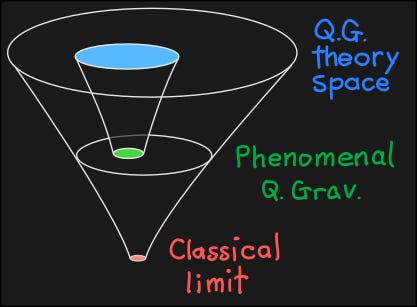
Experiments pin down the green region. All the old physics tells use we have to be in the regions that can pull back to the little red region.
Superposition without Superposition
The T4G view is that particles (hence all gravitational masses) are never truly in superposition. It is the indivisible stochastic dynamics which makes things appear to be in superposition, but those appearances are a bias in your thinking born from using a wave function in some high dimensional Hilbert space to describe the time evolution of the probability density matrix.
Never confound your model for the actual reality of the world.
If you use a wave function to describe particle processes you will be more inclined to see the interference as a physical superposition additive effect. But obviously it is not, the wavefunction is a Hilbert space ray, it is not a ‘wave’. You can never observe the phase of these rays, you can only measure consequences of phase differences. That is the quintessential hallmark of a nonphysical description. If you have no alternative then you can do something like “lift up” the Hilbert space ray to the status of ultimate reality, but you do not have to, because for QM there are alternatives that show you how the phase is nonphysical. ISQM is one, T4G is another.
It makes one think harder about what are the phase differences then?
Note that the probability density matrix, in any case, is more general, and I would say more fundamental than the `wavefunction' (which is a Hilbert space ray representation of only pure states). But this is a moot point, because to my mind QM is a probabilistic theory of measurement, so is not even a fundamental theory, so who cares what objects in the model are “more fundamental”? It’s a dopey question, and also dopey because it confuses the objects in a model with the noumena of physical reality.
However, it is not clear to me that T4G predicts no superposition whatsoever, since with closed timelike curves we can actually get particles looping back in time. If you are insisting on a smooth Hamiltonian time evolution story, then to describe such time loops, or even merely account for them, you will need superpositions, and not in just the probability ensemble sense, in the real sense.
What we cannot have is some intermediate measurement of a particle in such cases, since then the time loop by definition has not occurred. We can only detect particles after they’ve traversed the time loop. Which is consistent with the CTCs being generated by wormholes — we cannot probe inside a wormhole due to topological censorship.
This is, by the way, a nice case for spacetime realism: if indeed we cannot probe entanglement structure, then the only reasonable parsimonious theory for this is the spacetime wormhole account. In what other theory of entanglement is topological censorship so natural?
What this all means is that T4G could predict some very weak actual mass superposition effects.
However,
(a) they would not then be proof the spacetime metric itself is ever in superposition.
(b) It would not be evidence of gravitons.
Xerses' Counting Problem
Change of topic now.
Here Xerses Arsiwalla is talking about Topos theory as a foundation for quantum gravity. This is based on Chris Isham’s body of work. You know, that led absolutely nowhere in quantum gravity, but did merge a bit with Category Theory and so has become useful mathematics. But it has not proven useful in physics yet. Maybe it will in the future, who knows?
The thing is, Category Theory and Topos Theory are too general and abstract to be a foundation for physics. A Physics must make some ontological commitments. If all you do is invent a new universal language, then that’s admitting all possible worlds, it cannot possibly pick out our particular physical cosmos.
The thing about general languages is that they are very useful, and sometimes choosing a language is not trivial, and can make a difference for how difficult your work will be, or easier. (This made me think of Edsger Dijkstra, who I will mention again below.)
Such general language systems might be very useful for thinking about the Many Worlds Interpretation of quantum mechanics. But we all know that basket of madness is not physics, it’s pure mathematical fantasy, which is why the general language can be useful for Its study.
Around 40 minutes in Xerses tries to assert that the fundamental assumption is discreteness, but then switches to say “That’s not quite right,” and “it is really an issue of the Finite versus the Infinite. If Finite then we have computation.”
OK, I get what he’s saying, but I think that’s wrong, or, shall we say, wrong-headed — for it might be true our cosmos is Finite and “A Computer” but there is no damn reason in the world to presume it is so.
My comment:
@43:00 seems far too ideological. In physics experiment rules, not our preconceptions of what “pregeometry” means. It is not just about the Finite versus the Infinite. With continuum spacetime we already have Finite and discrete in the homotopy. Gravity is holonomy. Finite discrete particle physics is in the homology, to which you can somewhat apply some discrete computational models. But continuum spacetime would be still ruling the roost so-to-speak. At least that’s one alternative conception. If the whole universe is a 4D spacetime, then there’s nothing “pregeometric” about it, there is however pregeometry in how we abstract and formalize our understanding of things when the geometry is a bit dodgy (as it is in quantum gravity). But you all should know that nontrivial spacetime topology yields a quantum theory.
Here I am not arguing from a moral or political stance, although I could go on a riff about how computationalism is effecting our zeitgeist and our society and politics, and not for the Good. But I will leave that for my MMT website .
However, I do consider it slight immoral to make presumptions like Arsiwalla’s when doing physics. Because it is intellectually dishonest. At best it is loose use of language (and we are all guilty of that sometimes, no one is perfect in language, not even Edsger Dijkstra).
You see this social phenomenon all over the place: people expert in field XX think the whole damn universe is described by theories of XX type. Linguists seem to think all things emerge from syntax; Economists think all is supply–demand theory; Computer scientists think all is computation; Psychologists think all is in the mind; Marxists think all reality is historical force; Hippies think all reality is an hallucination; et cetera, et cetera.
At the very least, most people credentialed in some field of study tend to grossly inflate the importance of their field. I do that myself a little bit perhaps with MMT (I’ll leave you to be the judge), although I think I always back up my claims. I’ve never claimed MMT is all of macroeconomics, it isn’t, it is merely an understanding of existing monetary operations.
Guys (mostly guys) you need to step back sometimes from your own ego and admit other fields of study have some importance too!
And… guys… the physicists are the only ones who really have some sense of what physical reality is, and listen up! — they all say they have no idea what the base marble is! (At least the honest non-grifty physicists.) So maybe pay heed to the actual experts in the field of X≡PhysicsX. That does not give you, Mr TimeyWhimmy expert, license to go and fill the void left by the physicists who honestly admit they do not know what the base marble is. You could, but you need to at minimum reproduce all of known physics (or let’s say 99% coverage but in particular the solidly verified phenomenology). None of the Alt-Physics crowd have ever done that, not that some genius some time cannot, just none yet have.
So I was not enjoying that little ideological exertion from Arsiwalla.
Instead, the honest way to go about theory building is to start with an Hypothesis. Sounds a bit too Old School? Well, sorry to say you youngsters, Old is sometimes better. Or so wine buffs tell me. It can also turn to acetic acids, but you know what we mean. (Am I crazy, but wasn’t the pop & rock of the 50’s through 70’s, even 80’s and 90’s', just far superior to today’s slop on Spotify and iTunes? Radiohead was a 1970’s band, you must understand, they just had a time machine handy.)
By the way, I realize this is off topic, but there was a lot to like about Edsger Dijkstra. They say he was a bit of a character, but I think although not a Feynman, in some ways he was better than RPF.
Who cannot love a guy who had no references or bibliography? His writing was largely self-contained. That’s precious. And he “saw teaching not just as a required activity but as a serious research endeavour.” That’s my kind of geek. (Feynman was similar, as was Vikki Wiesskopf.)
There was also some not to like: imagine trying on the idea of a commercial company that commercializes production of mathematical theorems. Flies in the face of the entire history and culture of mathematics dude! Not to mention would cause Richard Stallmann to hack all your theorems rendering your commercialization useless. (Basically, mathematicians are communists, albeit with regard perhaps only to their mathematics.)
Anyway, back to Arsiwalla.
He made some comment about our motivation is “to be finite.” Whoa! I had to comment:
No. @45:00 our motivation should not be “to be finite”. Our motivation is to know about reality, whether reality is infinite or not. Being finite is a constraint on physical models, because we know we cannot solve all models analytically, and cannot numerically experiment or gather physically infinite numbers. But the model we use is not physical reality Itself. Never confuse the two (the model for the system itself) it leads to nerd brainworms. Never make presumptions that are not necessary. Presuming the cosmos is a computation is an unnecessary assumption — maybe it is a computation, maybe it isn’t, but assuming it is is not a scientific hypothesis if you cannot prove it. You should prove it, not presume it. A model (say like continuum 4D spacetime, or a spin network) is not a presumption, it’s just a model.
I wanted to comment more about using 4D spacetime as a model. However, in T4G theory I find things so beautiful I am drawn to taking it as near proof physical reality is a 4D manifold.
However, in T4G theory 4D spacetime is still only the model, not reality.
Great piece but if fields are just math, how does Earth’s magnetic field hold its atmosphere? Fields aren’t abstractions. They’re the reason objects behave at all.
I take your point about the algebraic definition of a field. But to me, physics is algebra and not as abstract manipulation, but as the logic of the field itself. The four operators are just the phase operations the field performs, and algebra is our way of writing that down.
That’s why I find it odd to treat manifold/curvature as “real” but fields as “fiction.” We can’t see either because both are descriptions. It’s like saying the Spanish word agua is real but the English word water isn’t. What’s real is the liquid (the recursive structure both words point to). Newton’s forces are the same and are not real things, just words for what the field does.
So for me, the ontology isn’t in “field” or “manifold” as labels, but in the recursion that algebra encodes. Fields aren’t abstractions layered on geometry, they are geometry-in-action. And because reality is always in action, from the smallest particle-field to the largest universal field, it’s all the same field dynamics across scales. One continuous electromagnetic field whose structure you can measure directly in the vacuum.