Dalek Gravity
Interference... exterminate, exterminaaate, exterminaaaaate!

Another day, another chance to write on T4G theory. (Original post on T4GU — Unorthodox Gravity).
I was gravitated towards Joseph Samuel who wrote a nice paper on how gravity can cause quantum decoherence (destroy interference).
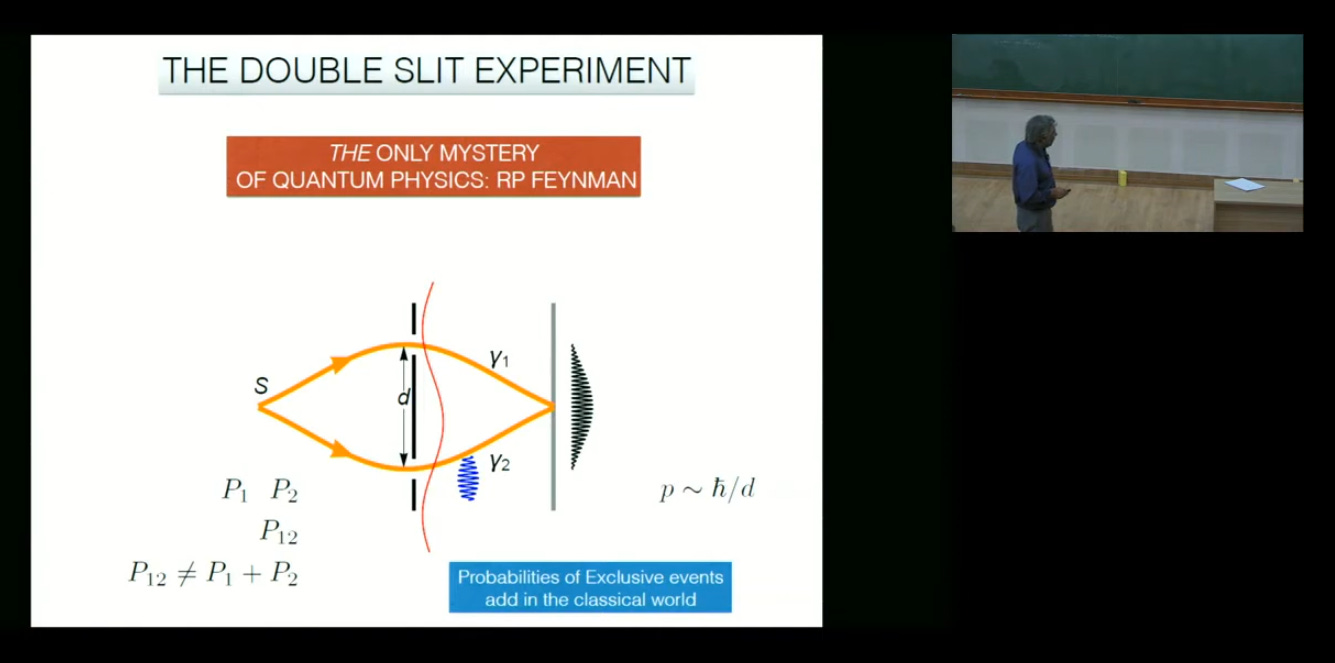
Two Nice Gedankenexperiments
He contrasts two gedankenexperiments,
E1. do a two-slit experiment in a thermal bath.
E2. do a two-slit experiment with an accelerated frame to create a thermal bath from the Rindler horizon.
They are slightly different results, but both will gradually dissolve away the interference pattern as the thermal temperature increases. Basically the wavelength of noisy photons goes as 1/T.
But the main point is that both simulate gravity causing decoherence if we accept the Equivalence Principle. (We do accept.)
There was a nice discussion at the end of the talk Samuel gave .
It was funny too. How the dickens can a string theorist not comprehend the Unruh Effect? (Mind you, I still do not fully comprehend Unruhitty even after last weeks effort, I merely think I comprehend it.)
T4G Guy Butts In
I think I can summarize my T4G take on the discussion.
I wrote:
Hey Joe, (ignoring Suvrat who was thinking of non-gendanken Daleks🤣, just sticking to gedanken) if gravity really is quantum in the sense the soft gravitons can be in perfect superpositions, then there should be no decoherence, and you are back to either mystical “collapse” nonsense or Many Worlds nonsense. Right? The Rindler observer can see loss of interference because they lose sight of the soft gravitons, if they could regather that information they can reconstruct interference (a somewhat complicated procedure of course, probably NEXP hard or something).
When entanglement is present it is only the whole system that truly exhibits interference. So, would you say, gravity can cause decoherence, but “so what?” because anything can cause decoherence that breaks the subsystem entanglement and forms entanglement with the “rest of the Lab and other garbage”.
What does that all mean for whether gravity is “quantum” or “postquantum” or “was already quantum all along” is I think the next sharper question.
I’d suggest gravity (spacetime topology) is the cause of entanglement so was always quantum, just not in the hydrodynamic (Jacobson) limit where entanglement is statistically washed away so-to-speak. In the hydrodynamic (Einstein) limit you disregard all local topology and treat it’s effects as “mass” and hence lose entanglement, and hence make the model classical. But this implies the ‘quantunmness’ of gravity is not in superposition of the metric or of gravitons, but is rather in the Planck scale topology (in the entanglement structure, or ER=EPR). Remember, from GPT/QIT or ISQM (indivisible stochastic QM) frameworks: entanglement implies superposition.
Is it non-classical probability summing?
While listening to Samuel I had a little Splinter in the Mind, one that previously has been dormant or nascent.
When quantum physicists say that in QM the probabilities do not sum for mutually exclusive events, so in the two-slit: P12≠P1+P2 or,
I tend to get the itch from that Splinter.
I do not disagree with QM, T4G is fully compliant with QM, or derives QM. The point of T4G Theory however, is that QM is incomplete in the T4G picture. QM leaves entanglement mystical and unexplained, it is a mere correlation (in both QM and in QFT, the most advanced theory).
T4G is more like the AdS-CFT duality picture: entanglement statistics are dual to wormholes. In fact I think T4G explains the duality, but that’s not my field of expertise, and in any case who cares?, since our universe is not AdS. What you want is a straight-up account for entanglement, no duality.
Anyhow, I’ve always thought it is silliness to say the probabilities are “non-classical”. Probabilities are not physics, they are neither classical nor quantum.
What physicists do is bend the rules, and talk about what they believe are mutually exclusive events which clearly are not mutually exclusive. So no wonder stupidity and weirdness follows.
Jacob Barandes provides a much clearer picture:
the probabilities are always mathematical (neither ‘classical’ nor ‘quantum’ since probabilities are not physical concepts). Probabilities are merely useful math tools employed by physics.
The critical distinction between classical mechanics and quantum mechanics is non-Markov transition probability. Quantum Physics cannot forget the distant past, classical mechanics can (most of the time).
The edge cases where maybe classical mechanics needs long past time data are rare I believe, and I do not have any instances to mind. I guess Gödel universes qualify. Or if cosmic strings are found then whipping electrons around them might be another example.
What about Two-Slit interference then (or any other type of single-particle self-interference)?)
And “No!” the single particle is not a wave folks. That’s humbug physics.
In any case, our challenge is to account for the seeming paradox of self-interference of a particle, no wave language allowed. For the bondage and discipline of it, the challenge. Wave models are intellectual slop.
Barandes only does part of the job, since he does not explain entanglement, or equivalently, he does not explain why the particle state transitions are non-Markov and Indivisible (do not factor unitarily over time intervals).
So this is one way to weakly explain how Two-Slit interference is classical probability. It is the fact that we cannot factor the transition matrix over time intervals for which entanglement is relevant. But the probabilities are still classical.
It is because we cannot factor the transition matrix that we need some trick or device, like Hilbert space amplitudes, to compute the classical probability distribution, which admits the interference terms.
There never were any “quantum probabilities”. There was only non-Markov transition dynamics.
The other way to do the calculation is with the sum-over-histories path integral. But again, that’s a fictional accounting tool, just like the wavefunction. The probabilities are still always classical (Kolmogorov) all the time, by which I mean mathematical (not “classical mechanics”).
None of this betrays QM. The world is still quantum mechanical. It’s just that we can stop talking about “classical probability” since there is no such thing, there is only Probability. QM obeys the rules of Probability Theory.
Let me try again another way.
Suppose someone truly believes in superpositions (say a Many Worlder). And comes to you with some Schrödinger dice. Are you going to use probability theory for Casino dice? No. Are you going to use probability theory for superpositions? Yes. (You desire to win I suppose.) Plain old probability theory.
What changed was not mathematical probability theory, what changed was how you view a single dice.
It is a Schrödinger dice, not James Bond’s dice, one that obeys indivisible (non-Markov) transition dynamics. Purely Kolmogorov probability all the way.
Unruhitty link goes to a local host. I don’t know if you want to fix it